
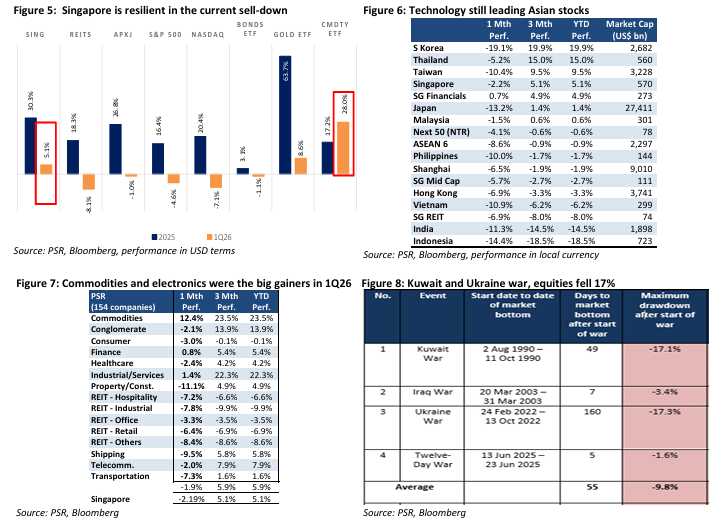
Review: Singapore equities ended a record ten consecutive months of gains with a
2.2% decline in March. 1Q26 was still a positive 5.1%. The market registered all-time
highs on 23 February. The Iran war drove up the performance of sectors in defence
spending, biofuels and capital markets (Figure 2). Banks managed to maintain gains
even in March and outperformed during the quarter with their resilient dividends
(Figure 1). REITs were pummelled as interest rate expectations dialled back from two
cuts early this year to the possibility of rate hikes (Figure 3). Consumer is another
segment of weakness as rising inflation squeezes disposable income (Figure 4).
Outlook: In a fog, the path in front is obscured, and every step risks a major fall. The
strategy is not to predict but preserve capital. Equities have morphed into a volatile,
levered short option on oil prices. With more troops being deployed into the region,
the risk of US ground forces and a prolonged war remains high. The closure of the
Straits of Hormuz is not only driving higher energy prices and inflation, but a risk of a
material shutdown in global production due to the unavailability of materials. During
the pandemic, vessel availability and lead times were the bottlenecks. The current
situation can be worse. There is no supply of feedstock or materials for product
manufacture. In Singapore, there have already been force majeures at chemical
facilities that have impacted multiple industries, including plastics, packaging, medical,
auto, food, and fragrance. Since the war began, US equities have been down 4.3%.
This is compared with the trough drawdown of around 17% in the last two wars,
significantly impacting energy markets – Kuwait and Ukraine (Figure 8). There is a
pathway for current oil prices to reach US$200 per barrel. The last Middle East conflict
that saw a major spike in oil prices was the Kuwait war (2Aug90). Crude oil price
jumped from an average of US$15 (Jun90) to a peak of US$42 (Oct90), a 275% rise.
Assuming a similar rise of Brent oil average of US$68 (Jan26), it implies a $187 peak
(Figure 9). The impact could be worse. Kuwait and Iraq were 7% of the global oil supply
that was embargoed. The current estimated impact is 10%. The Kuwait war had the
threat that Iraq could also invade Saudi Arabia. This is no different from Iran destroying
much of the Gulf oil infrastructure. In Singapore, the macro data has been strong, led
by semiconductor exports surging 51% in February. Loan growth continues to creep
up with a 6.3% increase in February. Loan growth is the fastest in more than four years.
Building materials demand is also surging, with January demand for ready-mixed
concrete up 47% YoY (Figure 10) and steel bars 124%. However, tourism is sluggish,
with YTD arrivals down 0.3% YoY. Interestingly, RevPAR has been resilient, rising 5%
YTD2/26. Singapore is attracting more high-value tourists (Figure 11).
Recommendation: We believe the war in Iran will broaden the existing capex cycle
underway globally. The key capex cycles are: (i) Data centre spending: Hyperscalers or
Big tech are ramping up their capex for AI and data centres by around 60% in 2026
(Figure 12). Singapore recently requested applications for 200MW of new data centres
in Jurong. The fragility of Gulf infrastructure will invariably lead to more data centres
being built in Asia. (ii) Semiconductor: Demand for AI and memory chips is dramatically
pushing up the rollout of foundry capacity and equipment (Figure 13). (iii) Defence:
Countries will push for more domestic military capabilities, as seen by NATO countries
raising their defence budgets (Figure 14). (iv) Renewable: Energy independence
becomes a national security priority as the Straits of Hormuz is weaponised. (v)
Construction: Singapore is enjoying a multi-year increase in construction demand.
Primary beneficiary of the current capex cycle and small-mid cap stocks (Figure 15). In
the data centre buildout, the primary beneficiary is IT service companies. Telechoice
has announced it is bidding for a material data centre project in the region. Frencken
will ride on the massive jump in semiconductor equipment demand from its key
lithography customer. Oiltek is tapping into the emerging demand for sustainable
aviation fuel oil. REITs will be the near-term underweight. In a stagflationary
environment, it will face pressure on rents, higher interest expenses and valuation
compression (Figure 16).
Important Information
This report is prepared and/or distributed by Phillip Securities Research Pte Ltd ("Phillip Securities Research"), which is a holder of a financial adviser’s licence under the Financial Advisers Act, Chapter 110 in Singapore.
By receiving or reading this report, you agree to be bound by the terms and limitations set out below. Any failure to comply with these terms and limitations may constitute a violation of law. This report has been provided to you for personal use only and shall not be reproduced, distributed or published by you in whole or in part, for any purpose. If you have received this report by mistake, please delete or destroy it, and notify the sender immediately.
The information and any analysis, forecasts, projections, expectations and opinions (collectively, the “Research”) contained in this report has been obtained from public sources which Phillip Securities Research believes to be reliable. However, Phillip Securities Research does not make any representation or warranty, express or implied that such information or Research is accurate, complete or appropriate or should be relied upon as such. Any such information or Research contained in this report is subject to change, and Phillip Securities Research shall not have any responsibility to maintain or update the information or Research made available or to supply any corrections, updates or releases in connection therewith.
Any opinions, forecasts, assumptions, estimates, valuations and prices contained in this report are as of the date indicated and are subject to change at any time without prior notice. Past performance of any product referred to in this report is not indicative of future results.
This report does not constitute, and should not be used as a substitute for, tax, legal or investment advice. This report should not be relied upon exclusively or as authoritative, without further being subject to the recipient’s own independent verification and exercise of judgment. The fact that this report has been made available constitutes neither a recommendation to enter into a particular transaction, nor a representation that any product described in this report is suitable or appropriate for the recipient. Recipients should be aware that many of the products, which may be described in this report involve significant risks and may not be suitable for all investors, and that any decision to enter into transactions involving such products should not be made, unless all such risks are understood and an independent determination has been made that such transactions would be appropriate. Any discussion of the risks contained herein with respect to any product should not be considered to be a disclosure of all risks or a complete discussion of such risks.
Nothing in this report shall be construed to be an offer or solicitation for the purchase or sale of any product. Any decision to purchase any product mentioned in this report should take into account existing public information, including any registered prospectus in respect of such product.
Phillip Securities Research, or persons associated with or connected to Phillip Securities Research, including but not limited to its officers, directors, employees or persons involved in the issuance of this report, may provide an array of financial services to a large number of corporations in Singapore and worldwide, including but not limited to commercial / investment banking activities (including sponsorship, financial advisory or underwriting activities), brokerage or securities trading activities. Phillip Securities Research, or persons associated with or connected to Phillip Securities Research, including but not limited to its officers, directors, employees or persons involved in the issuance of this report, may have participated in or invested in transactions with the issuer(s) of the securities mentioned in this report, and may have performed services for or solicited business from such issuers. Additionally, Phillip Securities Research, or persons associated with or connected to Phillip Securities Research, including but not limited to its officers, directors, employees or persons involved in the issuance of this report, may have provided advice or investment services to such companies and investments or related investments, as may be mentioned in this report.
Phillip Securities Research or persons associated with or connected to Phillip Securities Research, including but not limited to its officers, directors, employees or persons involved in the issuance of this report may, from time to time maintain a long or short position in securities referred to herein, or in related futures or options, purchase or sell, make a market in, or engage in any other transaction involving such securities, and earn brokerage or other compensation in respect of the foregoing. Investments will be denominated in various currencies including US dollars and Euro and thus will be subject to any fluctuation in exchange rates between US dollars and Euro or foreign currencies and the currency of your own jurisdiction. Such fluctuations may have an adverse effect on the value, price or income return of the investment.
To the extent permitted by law, Phillip Securities Research, or persons associated with or connected to Phillip Securities Research, including but not limited to its officers, directors, employees or persons involved in the issuance of this report, may at any time engage in any of the above activities as set out above or otherwise hold an interest, whether material or not, in respect of companies and investments or related investments, which may be mentioned in this report. Accordingly, information may be available to Phillip Securities Research, or persons associated with or connected to Phillip Securities Research, including but not limited to its officers, directors, employees or persons involved in the issuance of this report, which is not reflected in this report, and Phillip Securities Research, or persons associated with or connected to Phillip Securities Research, including but not limited to its officers, directors, employees or persons involved in the issuance of this report, may, to the extent permitted by law, have acted upon or used the information prior to or immediately following its publication. Phillip Securities Research, or persons associated with or connected to Phillip Securities Research, including but not limited its officers, directors, employees or persons involved in the issuance of this report, may have issued other material that is inconsistent with, or reach different conclusions from, the contents of this report.
The information, tools and material presented herein are not directed, intended for distribution to or use by, any person or entity in any jurisdiction or country where such distribution, publication, availability or use would be contrary to the applicable law or regulation or which would subject Phillip Securities Research to any registration or licensing or other requirement, or penalty for contravention of such requirements within such jurisdiction.
This report is intended for general circulation only and does not take into account the specific investment objectives, financial situation or particular needs of any particular person. The products mentioned in this report may not be suitable for all investors and a person receiving or reading this report should seek advice from a professional and financial adviser regarding the legal, business, financial, tax and other aspects including the suitability of such products, taking into account the specific investment objectives, financial situation or particular needs of that person, before making a commitment to invest in any of such products.
This report is not intended for distribution, publication to or use by any person in any jurisdiction outside of Singapore or any other jurisdiction as Phillip Securities Research may determine in its absolute discretion.
IMPORTANT DISCLOSURES FOR INCLUDED RESEARCH ANALYSES OR REPORTS OF FOREIGN RESEARCH HOUSE
Where the report contains research analyses or reports from a foreign research house, please note:
Paul has 20 years of experience as a fund manager and sell-side analyst. During his time as fund manager, he has managed multiple funds and mandates including capital guaranteed, dividend income, renewable energy, single country and regionally focused funds.
He graduated from Monash University and had completed both his Chartered Financial Analyst and Australian CPA programme.